



Introduction
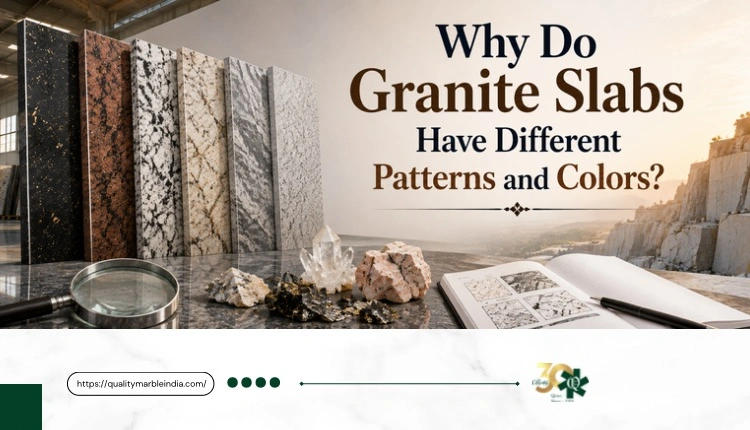
Walk into a natural stone warehouse and you may see granite slabs from the same quarry showing noticeably varied shades, crystal sizes, and mineral arrangements. This is not a processing defect. It is a direct result of how granite formed beneath the earth and how its mineral composition changed across a geological formation. Understanding granite color variation and granite pattern variation is important for anyone specifying stone for architectural surfaces, especially when several slabs need to work together in one installation.
Granite is an igneous rock formed when molten material cools slowly beneath the earth's surface. During this process, minerals crystallize at different rates and in varying concentrations. Quartz, feldspar, mica, amphibole and other minerals contribute to the final appearance. Pressure, temperature, cooling conditions and local geological composition also influence crystal size and distribution.
For architects, fabricators, importers and procurement teams, this geological background has a practical value. It explains why a sample should never be treated as a guarantee of the exact appearance of an entire shipment.
Why This Material Is Popular
Granite is specified across residential architecture, premium commercial spaces, institutional projects and architectural landmarks because it combines a broad visual range with useful physical characteristics. A single material category can move from fine grained black surfaces to coarse crystalline whites, warm reds, subdued greys and stones carrying prominent mineral movement.
Its suitability also extends beyond visual considerations. Granite can be processed into calibrated slabs, tiles, stair components, vanity tops, countertops, wall cladding, paving elements and custom architectural pieces. The selected variety, thickness, finish and fabrication method are usually determined by the intended application.
For international buyers, consistency within a selected block or production lot can be just as important as the base color. Experienced granite suppliers in India therefore assess quarry blocks, slab production, finishing and quality inspection as connected stages rather than treating the finished slab as an isolated product.
Technical Specifications
Specification | Typical Granite Characteristics |
Stone Type | Natural igneous stone |
Origin | Quarry-dependent; major Indian sources include Rajasthan, Karnataka, Andhra Pradesh, Telangana, Tamil Nadu and other regions |
Primary Color | Black, white, grey, red, brown, green, pink and mixed mineral tones |
Available Thickness | Commonly 15, 18, 20 and 30 mm; custom thicknesses may be available |
Surface Finishes | Polished, honed, leathered, flamed, brushed and other project-specific finishes |
Water Absorption | Generally low, commonly around 0.2 - 1%; exact value varies by variety |
Heat Resistance | High resistance to normal architectural heat exposure; thermal shock and installation conditions should be considered |
Scratch Resistance | High, although mineral composition and finish influence surface response |
Frost Resistance | Suitable for many exterior applications when the selected stone meets project-specific freeze thaw requirements |
Edge Profiles | Straight, eased, bevelled, bullnose, half bullnose, ogee and custom profiles |
Technical values vary by granite variety and should be confirmed through the relevant test report before project specification.
What Creates Granite Color Variation?
Mineral Composition Determines the Base Color
The most direct explanation for granite color is mineral content. Quartz is commonly transparent, white or grey, while feldspar can contribute white, cream, pink or reddish tones. Biotite and other mica minerals often introduce black or dark brown flecks. Amphibole can add darker green, black or grey areas.
The proportions and distribution of these minerals determine the overall visual character of a slab. A granite containing abundant light feldspar may appear predominantly white, while a stone with higher concentrations of dark minerals can read as grey or nearly black.
This is why color should be evaluated at slab scale rather than from a small photograph. A close image may emphasize individual crystals while the complete slab presents a much more balanced visual field.
Geological Formation Controls Crystal Structure
Granite develops through slow cooling underground. The longer the molten material remains at elevated temperatures before solidifying, the more opportunity crystals have to grow.
This produces variations in grain size. Some granites have a compact, fine grained appearance, while others contain large visible crystals. The size and arrangement of these crystals contribute significantly to the perceived pattern.
Changes within the geological environment can also influence mineral concentration. As a result, one quarry area may produce material with a more uniform background, while another section of the formation may contain stronger mineral movement.
Trace Minerals Add Subtle Tones
Not every color visible in a granite slab comes from the dominant minerals. Small quantities of accessory minerals can introduce secondary shades and localized markings.
Gold, blue - grey, green, rust, charcoal and reddish notes may appear as small mineral concentrations within the main background. In many cases, these subtle variations are what make a particular quarry material recognizable.
For a project requiring close visual coordination, procurement teams should inspect representative slabs from the actual production lot rather than relying solely on a catalog image.
How Granite Pattern Variation Develops
Grain Size Creates Texture
Some granite slabs have a tightly packed visual field, while others display large interlocking crystals. This is primarily a geological characteristic rather than a surface treatment.
Fine grained granite can provide a quieter appearance for expansive flooring or contemporary wall applications. Coarser varieties may be selected when the mineral structure itself is intended to contribute to the design.
Mineral Distribution Creates Movement
Granite does not always display minerals in a uniform arrangement. Clusters, patches, bands and scattered crystals can occur depending on the geological formation.
This is particularly noticeable in slabs where dark and light minerals gather in irregular concentrations. When several slabs are installed adjacent to one another, the sequence of these patterns becomes an important fabrication and layout consideration.
Quarry Location Matters
A quarry is not necessarily visually uniform from one extraction zone to another. Blocks can vary according to their position within the geological deposit. Changes may occur in background tone, crystal size, mineral density and pattern intensity.
For commercial orders, this is why block selection and lot control matter. Exporters and processors often review production material before dispatch so that the shipment aligns as closely as practical with the approved reference.
Does Processing Change the Appearance?
Processing does not create the geological pattern, but the selected finish can alter how that pattern is perceived.
A polished finish increases surface reflection and can make colors appear sharper and mineral details more pronounced. Honing produces a softer, low-reflective appearance. Leathered finishes add tactile texture and can reduce the visual intensity of some mineral contrasts. Flamed surfaces are generally used where a textured finish is required, particularly for selected exterior applications.
Sawing direction also deserves attention. Depending on the structure of the stone, the cutting orientation can influence how mineral features appear across the slab. For projects requiring matched pieces, fabrication drawings should therefore consider slab direction before cutting begins.
Where Pattern and Color Matter Most
Granite selection is often closely linked to the scale and visual purpose of an application.
For large flooring areas, architects may prefer a controlled grain structure that does not compete with the surrounding architecture. Countertops and reception desks can accommodate stronger mineral movement because the stone is being viewed as a concentrated architectural feature.
Wall cladding and feature panels require another consideration: slab sequencing. When multiple slabs are placed across a large elevation, the relationship between individual patterns becomes part of the finished composition.
Staircases, vanity tops and custom furniture pieces typically involve smaller cut components. Here, the location of prominent crystals or color concentrations can influence where the fabricator places each template.
How to Choose the Right Material
The first step is to define the required visual range. Decide whether the project calls for a consistent background, pronounced mineral movement, fine grain or larger crystals. This narrows the selection considerably.
Next, review full slabs rather than small samples whenever possible. A sample is useful for identifying general color and finish, but it cannot represent every mineral feature that may occur across a larger surface.
For larger orders, ask about quarry block and production-lot consistency. If the installation includes multiple adjacent slabs, request slab images before fabrication. This allows architects and fabricators to establish an appropriate sequence and reduce unexpected visual breaks.
Technical suitability should remain part of the selection process. Water absorption, flexural strength, abrasion resistance, freeze-thaw performance and finish suitability should be checked against the intended application. Exterior applications in cold climates require particular attention to testing and installation details.
Quality Marble Exports India approaches this stage through production and quality inspection procedures that consider the stone's appearance alongside its intended architectural use. For international procurement, clear slab specifications, finish requirements, dimensions and inspection expectations should be agreed before production.
Why Choose Quality Marble Exports India
For a natural stone exporter, sourcing is only one part of the process. Block selection, slab processing, finishing, sizing, inspection and packing all influence the material received by an overseas buyer.
Quality Marble Exports India works with these stages as part of an integrated supply process. Manufacturing capabilities allow slabs and cut-to-size components to be prepared according to project requirements, while quality checks help identify variation in dimensions, finish and visual characteristics before dispatch.
Export orders also require practical coordination around packing, documentation and international shipping. For architects and procurement teams, this can be particularly useful when a project involves coordinated slab quantities or custom fabrication.
Frequently Asked Questions
Why do granite slabs have different patterns and colors?
Granite patterns and colors are primarily determined by mineral composition and geological formation. Quartz, feldspar, mica and other minerals crystallize in varying proportions and arrangements, producing the visible color, grain and movement across the stone.
Can slabs from the same quarry have different colors?
Yes. A quarry can contain material with variations in mineral concentration, crystal size and background tone. The extent of variation depends on the geological deposit and the specific blocks extracted.
Does granite pattern variation indicate poor quality?
No. Natural pattern variation is not, by itself, an indication of inferior material. Quality should be assessed through relevant physical test results, processing standards, finish consistency and suitability for the intended application.
Can the finish change the apparent color of granite?
Yes. A polished surface reflects more light and can make mineral colors appear stronger. Honed, leathered or textured finishes produce a more subdued visual response. The underlying mineral composition remains unchanged.
Should buyers approve a sample before ordering granite?
A sample is useful for establishing the general appearance, but larger projects should ideally review full slabs or representative production images. This is especially important when several slabs will be installed next to one another.
Does cutting direction affect granite patterns?
It can. The orientation of sawing may influence how mineral structures are presented on the finished slab. Fabricators should review the stone structure and project drawings before establishing cutting direction.
Is granite color related to its physical performance?
Color alone does not determine performance. Two granites with contrasting appearances can have comparable physical properties, while stones with similar colors may have different absorption, strength or abrasion characteristics. Technical data should therefore be reviewed for the specific variety.
How should architects handle variation in a large installation?
The most practical approach is to inspect the available slabs, establish a layout sequence and communicate acceptable variation before fabrication. For feature walls and expansive floors, slab mapping can help control the visual relationship between adjacent pieces.
Can granite be used for exterior applications in cold climates?
Many granite varieties are suitable for exterior use, but frost resistance should be confirmed through appropriate testing. Water absorption, freeze thaw performance, thickness, anchoring and installation design all influence suitability.
Conclusion
The answer to why granite slabs have different patterns and colors lies beneath the finished surface. Mineral composition, cooling conditions, geological location, crystal growth and quarry extraction all contribute to the character seen in a slab. Understanding granite color variation and granite pattern variation therefore helps professionals make more informed decisions rather than treating natural variation as an unexpected issue.
For architects, designers and buyers, the most useful approach is to assess the stone at full slab scale, verify technical data, understand the expected quarry variation and coordinate fabrication around the natural structure of the material. With appropriate selection and inspection, granite can be specified with a clear understanding of how its geological character will translate into the finished architectural application.
Quality Marble Exports India supports this process through stone sourcing, manufacturing, inspection and international supply, giving procurement teams a more informed basis for selecting natural granite for residential, commercial and architectural applications.


